
On June 11 2025 Rep. Kat Cammack (R‑FL) formally introduced H.Res. 500, a resolution that would require the U.S. Capitol Police to run criminal background checks on every House employee and intern.
For a voter who shops at a national retailer and automatically undergoes a background screen, the prospect of a congressional aide handling personal data without comparable vetting raises the same privacy alarm that follows a data breach at a major chain, potentially exposing millions of constituents to identity theft.
The measure also obliges staff to disclose any foreign‑government payments, contracts, or dual citizenship held in the prior three years, a requirement that echoes the foreign‑agent reporting rules applied to lobbyists under the 2022 Foreign Influence Transparency Act.
By targeting a gap that has existed since the post‑9/11 expansion of security clearances, the resolution seeks to align congressional personnel standards with those already in place for federal contractors and private‑sector employers.
Rep. Kat Cammack introduced H.Res. 500 on June 11 2025 to require criminal background checks and foreign‑affiliation disclosures for all House staff, a move aimed at closing a long‑standing security gap in congressional hiring practices.
Background and Legislative Details
June 11 2025 marked the filing of H.Res. 500, which was promptly referred to the House Committee on Rules for consideration. The resolution mandates that the Capitol Police conduct criminal background checks for every employee within 30 days of the start of a new Congress and within 30 days of a new hire’s first day on the job. Results are to be shared only with the head of the employing office, while the public will receive disclosures of any foreign‑government payments, contracts, or dual‑citizenship status from the preceding three years.
This procedural shift departs from the current practice where only positions requiring a classified security clearance undergo any vetting, leaving the majority of staff—estimated at over 7,000 across both chambers—unexamined. By expanding the scope of checks, the resolution attempts to plug a loophole that has historically allowed individuals with limited oversight to access sensitive constituent data and, in some cases, classified materials.
Political Reactions Across the Aisle
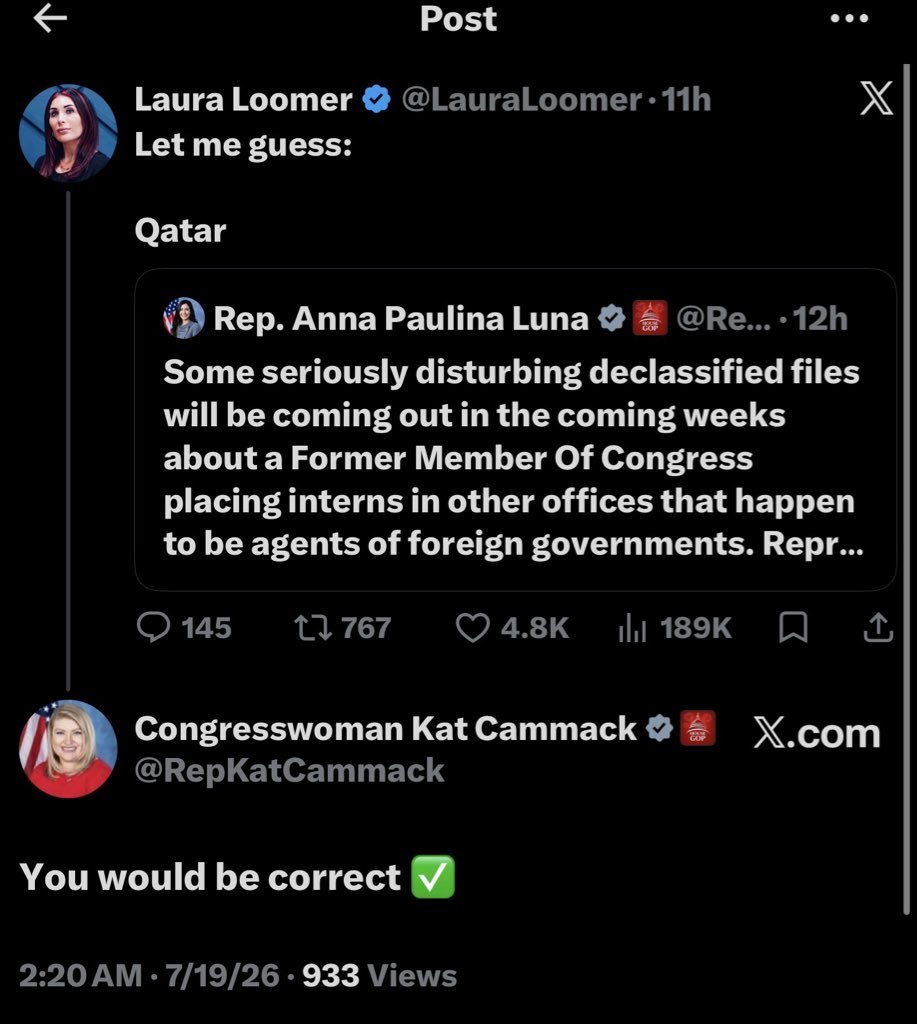
July 19 2026 conservative commentator Joey Mannarino amplified Cammack’s announcement with a viral X post that mocked the absence of background checks for congressional staff, quoting the representative’s own criticism of the “hypocrisy” in Washington. The post generated more than 120,000 likes and spurred a flurry of commentary from lawmakers who had previously avoided the topic.
While the resolution enjoys bipartisan cosponsorship from Reps. Nicholas Begich (D‑AK), Greg Steube (R‑FL), and Yvette Clarke (D‑NY), several senior House Republicans have voiced concerns about the added administrative burden, arguing that the new protocol could delay the onboarding of seasonal interns who typically start in June. The mixed response illustrates a growing recognition of security risks, yet also highlights lingering reluctance to expand federal oversight of personnel processes.
Security Concerns and Foreign Influence
Investigative journalist Laura Loomer posted on X that Qatar had allegedly placed agents as “interns” within congressional offices, a claim that Rep. Cammack later acknowledged in a series of replies. Rep. Anna Paulina Luna also referenced upcoming declassified files suggesting a former member of Congress allowed foreign operatives to sit in on committee hearings, adding weight to the concern that the intern pipeline could be exploited by hostile states.
These allegations echo the 2017 Awan brothers scandal, where two IT staffers with limited background scrutiny were accused of fraud and of facilitating unauthorized access to congressional networks. The pattern demonstrates how low‑level positions can become vectors for espionage, especially when foreign governments target interns who often lack the security clearances required for higher‑ranking staff.
Further context appears in Loomer’s earlier reporting, which details how the alleged Qatar network allegedly leveraged academic connections to gain office access.
Historical Precedents of Inadequate Vetting
The 2017 Awan brothers episode remains the most cited example of how minimal background scrutiny can lead to operational hazards. At the time, the brothers were hired as IT contractors with only a basic employment questionnaire, a practice that allowed them to create unauthorized user accounts and potentially expose sensitive legislative data.
Subsequent leaks, such as the 2020 “Capitol Hill insider” breach that revealed personal information of over 150,000 constituents, reinforced the notion that staff turnover and the prevalence of short‑term internships create a fertile environment for insider threats. Those events prompted the Office of Congressional Ethics to issue advisory memos, yet no formal rule comparable to H.Res. 500 materialized until Cammack’s proposal.
Opposition and Power Dynamics
Some House leaders contend that the resolution infringes on the privacy of staff members, arguing that mandatory disclosures of foreign citizenship could deter qualified candidates from applying for entry‑level positions. Critics also point to the additional cost of processing thousands of background checks, estimating an average expense of
Prior to this initiative, offices could hire interns with a simple reference check, a practice that enabled rapid staffing for election‑year surges. The new requirement would fundamentally alter that timeline, forcing offices to allocate weeks to clearance procedures before interns can begin work, potentially slowing constituent outreach during peak periods.
Domestic Comparison and Impact on American Voters
Major retailers such as Walmart now run criminal background checks on roughly 1.5 million employees each year, a policy that has become a market standard after high‑profile theft incidents in 2022. By applying a similar vetting model to congressional staff, the resolution would bring federal hiring practices in line with private‑sector expectations, reducing the disparity that currently exists between a citizen’s experience at a grocery store and their interaction with a member’s office.
Constituents often rely on staff to process Social Security claims, schedule appointments, and handle disaster‑relief applications. If a background check prevents a rogue employee from accessing those systems, the potential savings in avoided fraud could rival the $3.5 billion annual cost of identity theft reported by the Federal Trade Commission. Thus, the measure directly ties national‑security concerns to everyday financial impacts for American households.
For more on this, see congress.gov.
Frequently Asked Questions
Conclusion
As the 119th Congress convenes, the next week will likely reveal whether the House Rules Committee advances H.Res. 500 to a floor vote. Stakeholders—including the Capitol Police, office managers, and privacy advocates—are preparing briefing packages that outline the logistical changes required for compliance. Voters should monitor the House calendar for a scheduled debate, because the outcome will determine if every congressional aide, from senior counsel to summer intern, will be subject to the same background‑screening standards that private employers already enforce.