
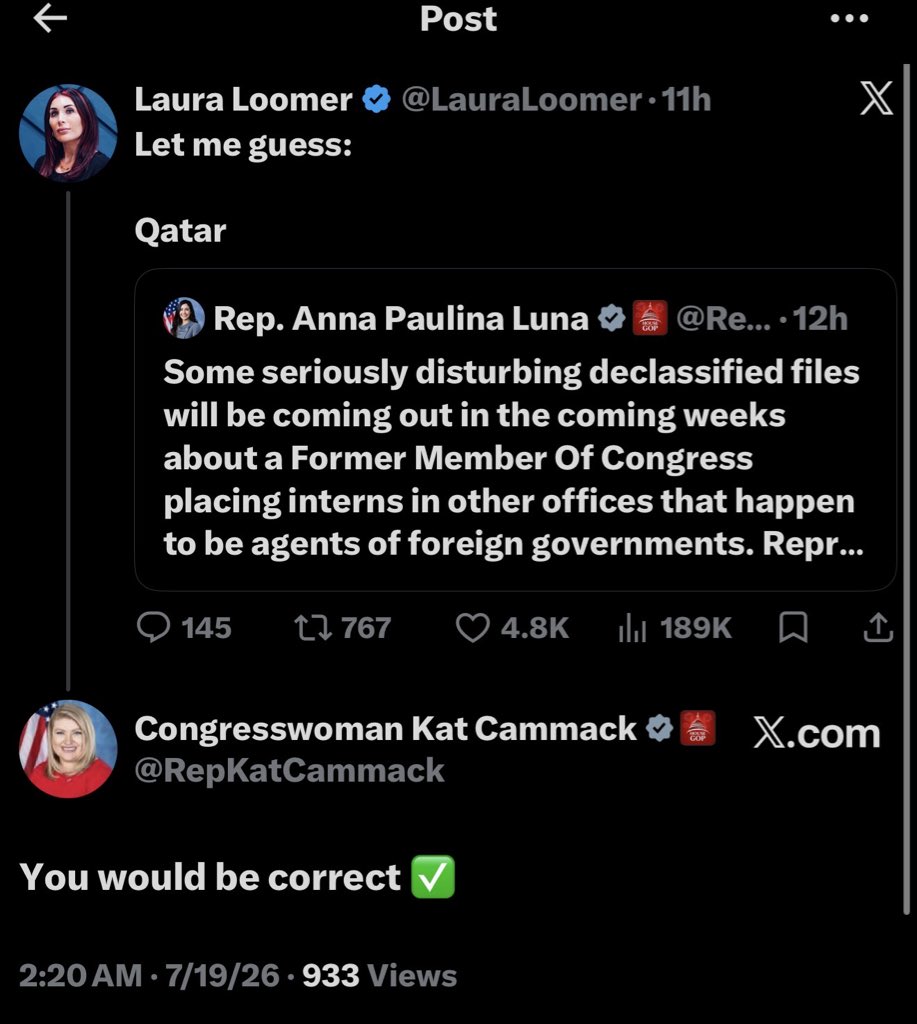
Laura Loomer says Qatar inserted foreign agents into congressional offices as interns. On July 19, 2026, the journalist posted a thread on X that cited Rep. Kat Cammack’s confirmation of the claim, prompting a wave of media attention and a renewed FBI probe. The allegation strikes at the heart of U.S. national‑security safeguards, especially as the 2026 midterm elections loom and both parties scramble to assure voters that Capitol Hill remains free of undisclosed foreign influence. By tying the alleged operation to Qatar—a state long accused of financing extremist groups and maintaining an aggressive lobbying footprint in Washington—the story forces lawmakers to confront how diplomatic and intelligence agencies monitor foreign actors embedded in legislative staff.
Laura Loomer reported on July 19, 2026 that Qatar placed undisclosed foreign agents in U.S. congressional offices masquerading as interns, a claim confirmed by Rep. Kat Cammack and currently under FBI investigation.
Background
Qatar’s diplomatic outreach intensified after the 2022 World Cup, with the Gulf nation funding cultural centers, think‑tank events, and scholarships across the United States. Historically, Washington has struggled to balance strategic partnerships with concerns that Doha finances the Muslim Brotherhood and Hamas. In that context, Loomer’s July 15, 2026 article on Loomered.com warned that “Qatar’s Agent In The House GOP” required a full congressional inquiry, laying groundwork for the later X post.
That warning matters because past incidents—such as the 2014 “Qatari‑funded lobbying” scandal involving the U.S. Chamber of Commerce—show how soft power can evolve into covert influence. When a foreign government places operatives in staff positions, it gains real‑time insight into legislative deliberations, potentially shaping policy before any public debate.

Key Facts
Forbes reported that the Department of Justice issued grand‑jury subpoenas and search warrants in early 2026 targeting a senior GOP staffer suspected of acting as an undisclosed Qatari agent for at least three years. The FBI also secured a gag order on Apple, demanding access to iMessage, WhatsApp, and Signal logs that date back to 2021.
- July 19, 2026 – Loomer posted the claim on X.
- July 20, 2026 – Article publication date.
- Three‑year period – alleged duration of the staffer’s covert work.
- H.Res. 500 – resolution introduced by Cammack demanding background checks on congressional interns.
- R‑FL – party affiliation and state of Rep. Kat Cammack.
These details matter because they reveal a timeline that aligns with the Biden administration’s 2024 “Foreign Influence Transparency Act” deadlines, suggesting the alleged activity may have slipped through existing reporting mechanisms.
Individuals
Laura Loomer, a former Project Veritas operative and founder of Loomered.com, has positioned herself as a conservative watchdog, frequently targeting what she calls “foreign infiltration.” Her role matters because her investigative style relies on social‑media leaks that mainstream outlets often overlook, giving her a unique conduit to raw documents.
Rep. Kat Cammack (R‑FL) responded to Loomer’s tweet with a simple “You would be correct ✅,” effectively validating the claim without naming the staffer. Cammack’s public confirmation adds credibility, yet her reluctance to disclose names reflects a tension between party loyalty and the public’s demand for transparency.
Rep. Anna Paulina Luna, also a Republican from Florida, announced the release of declassified files indicating a former member of Congress placed “interns” who were foreign agents. Luna’s involvement illustrates how multiple GOP members are now forced to address the same security breach, potentially reshaping intra‑party dynamics ahead of the midterms.
Responses
Speaker Mike Johnson (R‑LA) faced criticism for not naming the implicated staffer, a stance that appears to protect fellow Republicans from intra‑party fallout. Johnson’s hesitation underscores a broader GOP incentive to limit scandal exposure while preserving legislative cohesion.
Democratic leaders, including Senate Majority Leader Chuck Schumer, called for a bipartisan “foreign‑agent registry” to be fast‑tracked through the House Judiciary Committee. Their push reflects a Democratic incentive to portray the GOP as lax on security, potentially gaining electoral leverage.
FBI officials, speaking on condition of anonymity, confirmed that the investigation remains “active and expanding,” indicating that additional interns could be scrutinized. Law‑enforcement persistence matters because it signals that the agency will not accept political pressure to curtail the probe.
Consequences
If the investigation confirms that Qatar placed agents as interns, the Justice Department could pursue charges under the Foreign Agents Registration Act, a statute that carries up to five years in prison per violation. Such prosecutions would send a stark warning to other allied states that covert staffing is unacceptable.
Congressional optics also shift dramatically. H.Res. 500, already introduced by Cammack, may gain bipartisan support, leading to stricter vetting procedures that could slow the influx of interns—a change that might affect outreach programs for undergraduates seeking Capitol experience.
Comparing this episode to the 2015 “Chinese‑spy” intern scandal in the State Department reveals a pattern: foreign governments exploit low‑level positions to harvest policy insights, then retreat before detection. Recognizing that pattern helps lawmakers anticipate future vulnerabilities and allocate resources to counter‑intelligence training.
Readers interested in the broader legislative context can explore the earlier Loomer investigation for deeper background on how Doha’s influence network evolved.
Outlook
Future developments hinge on two competing incentives: the FBI’s mandate to uncover all foreign‑linked personnel versus congressional leaders’ desire to shield their members from scandal before the November 2026 elections. This tension may result in a limited public release of findings, even as private prosecutions proceed.
Lawmakers are expected to vote on an amendment to H.Res. 500 by early August, potentially expanding the definition of “intern” to include unpaid fellows and volunteers. Expanding the scope could deter foreign governments from exploiting loopholes, but it also risks burdening legitimate nonprofit programs that provide valuable civic education.
Stakeholders will watch the DOJ’s next filing, slated for the week of August 12, 2026, for clues about whether the agency plans to issue a public advisory. A public advisory could trigger a wave of resignations among staffers with dual citizenship, reshaping the demographic makeup of Capitol Hill staff.
Frequently Asked Questions
Conclusion
While the FBI continues to dissect digital footprints and Congress debates stricter vetting rules, the core uncertainty remains: will the investigation expose a single rogue staffer or uncover a broader network of Qatari‑linked operatives embedded across multiple offices? The answer will determine whether Washington tightens its defenses or confronts a deeper, systemic vulnerability.