
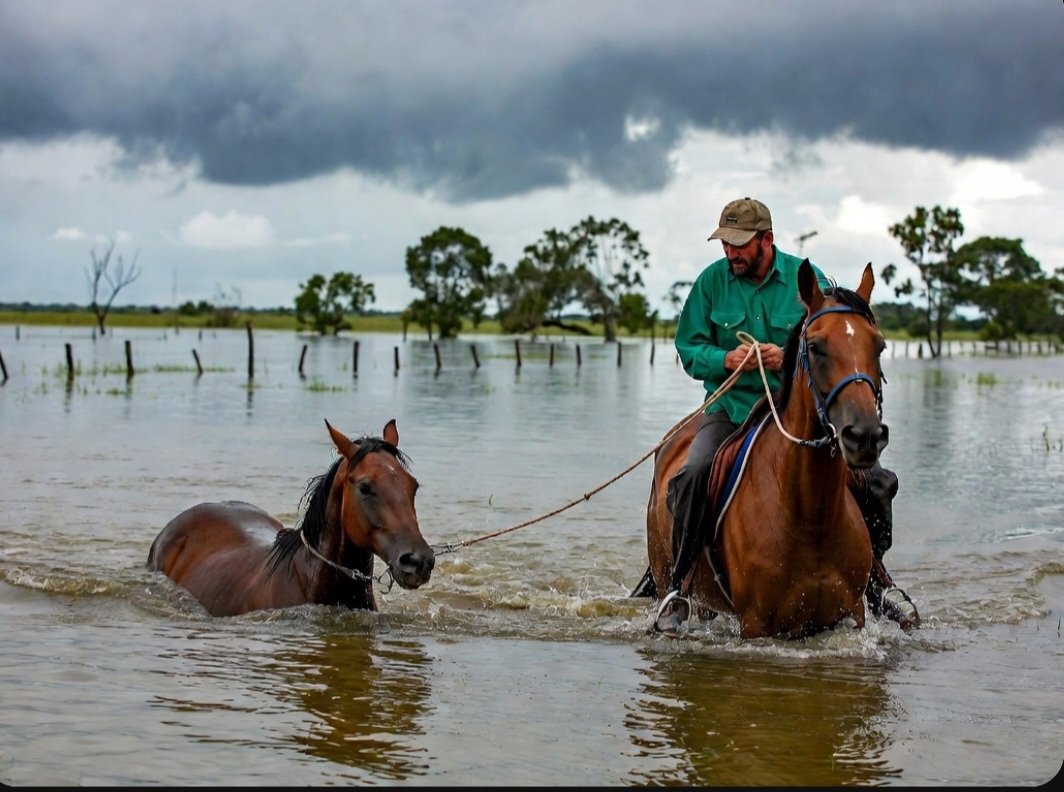
People often assume that viral moments on social platforms are fleeting and lack real‑world impact, yet the clip of a Texas rancher guiding a horse through floodwater has sparked a broader conversation about disaster response and animal welfare. As of July 20, 2026 the 58‑second video posted by @depressionlesss on X has been viewed more than 5 million times, turning a single act of bravery into a touchstone for community resilience. The significance lies not only in the numbers but also in how the footage has highlighted gaps in emergency planning for livestock, a subject that usually stays off the mainstream radar. By examining the rescue, the surrounding flood, and the ensuing online reaction, we can see why this story matters far beyond its viral status.
Chance Ward rescued a trapped horse during Hurricane Harvey’s 2017 floods in Cleveland, Texas; his 58‑second X video posted on July 20, 2026 has earned over 5 million views, drawing national attention to animal rescue efforts during natural disasters.
Background: Hurricane Harvey’s 2017 Floods
Hurricane Harvey made landfall in Texas in August 2017, dumping more than 60 inches of rain in parts of Liberty County and creating chest‑deep floodwaters that inundated farms, homes, and roadways. Residents of Cleveland, a small town of about 7,000 people, found their streets turned into rivers, with livestock penned on low‑lying pastures suddenly facing drowning hazards.
Such extreme precipitation aligns with a pattern of increasingly intense storms linked to a warming climate, a trend documented by the National Oceanic and Atmospheric Administration since the early 2000s. Understanding this context helps explain why local ranchers like Ward were forced to improvise rescue tactics while official crews struggled to reach every corner of the flooded landscape.
The Viral Clip and Its Reach
Video posted by the X account @depressionlesss on July 20, 2026 shows Ward on horseback entering a metal‑fenced enclosure and coaxing a dark‑colored horse toward higher ground. The clip quickly accumulated 5 million views, with comments praising the calm determination displayed in a chaotic setting.
Unlike many trending posts that amplify conflict or controversy, this footage resonated because it offered a clear, hopeful narrative—an ordinary person confronting a natural disaster without weapons, only a horse and steady hands. In the era of algorithm‑driven feeds, such positive content can cut through the noise, reminding users that social media can also serve as a conduit for uplifting, community‑building stories.
Chance Ward’s Rescue Tactics
Ward, a local feed‑store owner, rode his own horse through water up to chest depth, using the animal’s agility to navigate spaces boats could not reach. He approached the trapped horse, extended a rope, and guided the animal out of the fenced pen, a maneuver captured between seconds 0‑12 of the video.
Ranchers often possess intimate knowledge of terrain and animal behavior, a skill set that becomes crucial when conventional emergency assets are stretched thin. Ward’s ability to improvise demonstrates how community‑based expertise can fill critical gaps during fast‑moving crises, a lesson that emergency managers are beginning to codify in after‑action reports.

Community and Official Reaction
Residents shared the clip on local Facebook groups, while ABC News incorporated the footage into its August 2017 coverage of Harvey’s aftermath. The video’s spread prompted a surge of donations to regional animal shelters, illustrating how a single visual can mobilize resources beyond its immediate scene.
Such grassroots amplification often pressures authorities to address overlooked needs; after the clip went viral, the Texas Department of State Health Services referenced the rescue in a briefing on livestock assistance, showing that digital storytelling can influence policy dialogue in real time.
Why Animal Rescues Matter in Disasters
Floods across the United States each year threaten thousands of livestock, with the USDA estimating that more than 30,000 animals per major flood event face loss or injury. Economic studies show that each rescued horse can save a farmer roughly