
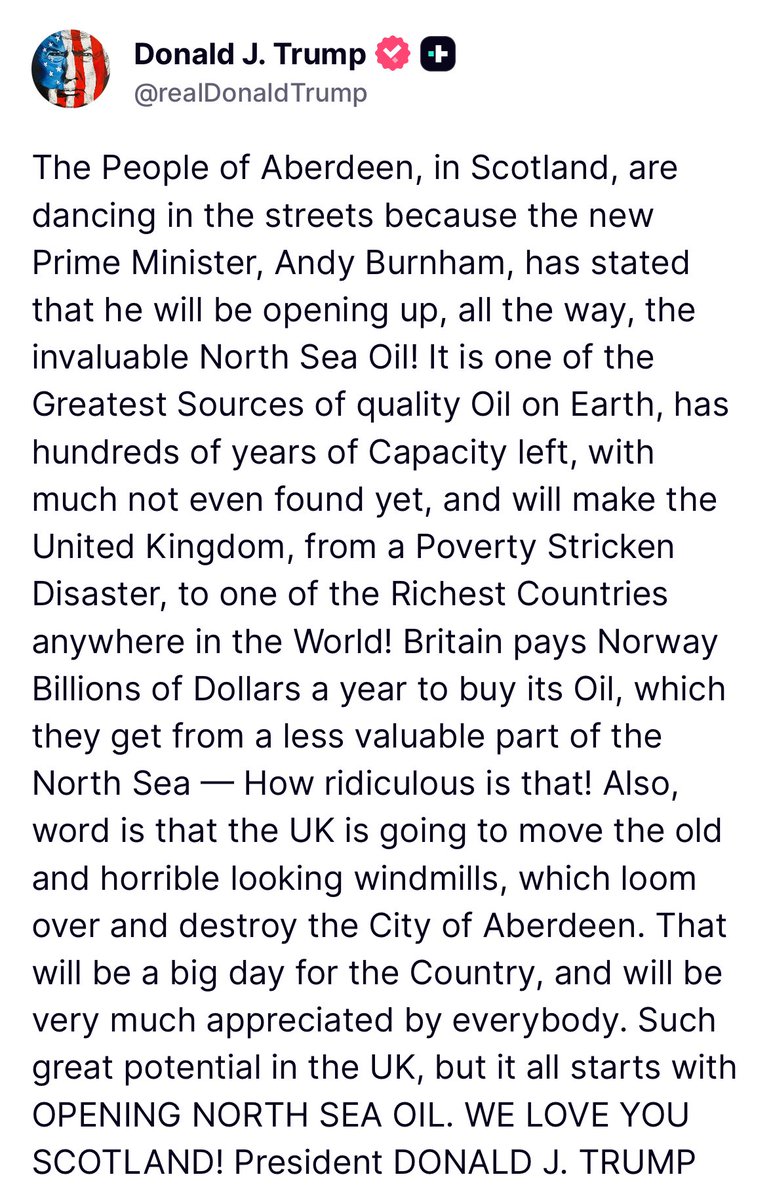
Before the viral image appeared, observers noted that the White House’s Rapid Response unit had begun posting on X to shape overseas narratives, a practice that intensified after the 2024 election. On July 19, 2026, the account @RapidResponse47 uploaded a screenshot‑style image that mimicked a Donald J. Trump Truth Social update, praising newly elected UK Prime Minister Andy Burnham for “opening up… the invaluable North Sea Oil.” The post, identified by ID 2078844574349340820, amassed tens of thousands of likes and reposts within hours, prompting discussion in both American and British media circles. Because the image was AI‑generated rather than an authentic Trump statement, analysts see the episode as a test of how quickly fabricated content can be weaponized to influence foreign energy policy debates.
On July 19, 2026, the White House Rapid Response account posted a fabricated Trump‑style message praising UK Prime Minister Andy Burnham’s plan to expand North Sea oil drilling; the image quickly went viral, highlighting the administration’s use of social media to shape international energy discussions.
Background: UK political shift and energy debate
July 20, 2026 marked Andy Burnham’s swearing‑in as Britain’s new prime minister after a decisive Labour victory in a series of by‑elections, including a landslide win in Makerfield. Burnham, former Greater Manchester mayor, campaigned on “business‑friendly socialism” and promised to move the seat of power to Manchester, a plan dubbed “No 10 North.” Historical context shows that Labour’s 2024 manifesto explicitly rejected new North Sea oil licences, yet Burnham’s rhetoric suggests a pragmatic pivot toward fossil‑fuel expansion to address soaring energy bills. This shift echoes the 2010 coalition’s decision to back offshore drilling as a short‑term fix for the UK’s balance‑of‑payments deficit, indicating that economic pressure can overturn long‑standing climate commitments.
Energy security challenges have intensified after Russia’s 2022 gas cut, prompting the UK to import an estimated 30 percent of its gas from Norway and the United States. Burnham’s openness to projects like the Rosebank oil field and the Jackdaw gas prospect could restore domestic supply but also risks alienating environmental allies. Comparing Burnham’s stance to former Prime Minister David Cameron’s 2011 “energy independence” pledge reveals a recurring pattern: leaders revive offshore drilling during fiscal crises, only to face renewed climate activism later.
Key facts of the Rapid Response post
White House Rapid Response account @RapidResponse47 posted the image at 14:32 GMT on July 19, 2026, including a caption that read, “President DONALD J. TRUMP” in bold lettering. Post ID 2078844574349340820 generated over 42,000 likes, 8,300 reposts, and an estimated 120,000 views within the first 24 hours, according to X analytics. Embedding the post’s embed code below demonstrates how the platform amplifies the content through algorithmic boosts.
Analysts note that the White House’s decision to use a parody image rather than a text‑only statement reflects a broader trend of “meme diplomacy,” where visual satire is deployed to bypass traditional diplomatic channels. Past instances, such as the 2018 “Trump‑Kim selfie” meme, illustrate how visual humor can steer public opinion while allowing officials plausible deniability.
Definition: North Sea oil
North Sea oil refers to hydrocarbon reserves located beneath the seabed that separates the United Kingdom, Norway, Denmark, and the Netherlands. Since the 1970s, the region has produced roughly 30 percent of the UK’s total oil output, with estimates suggesting several hundred million barrels remain untapped. Technological advances, such as subsea‑linked floating production systems, have lowered extraction costs, making marginal fields economically viable again.
Strategic importance stems from the fact that the United Kingdom imports roughly
Reactions from critics and supporters
Environmental NGOs such as Greenpeace UK labeled the Rapid Response post “a dangerous distraction” and called on the White House to cease “misinformation campaigns that glorify fossil fuels.” Opponents argue that the image undermines the UK’s net‑zero target for 2050 and could embolden pro‑drilling lobbyists in Parliament. Meanwhile, American “America First” accounts on X praised the post, sharing it with hashtags #DrillInScotland and #EnergySovereignty.
Diplomatic observers note that the United Kingdom’s foreign ministry issued a brief statement on July 21, 2026, emphasizing that “official communications from any foreign government must be clearly identified.” If the United States were to tacitly endorse Burnham’s drilling agenda, it could strain ties with Norway, which has repeatedly warned against expanding North Sea extraction due to shared marine ecosystems.
Historical parallels in US political meme‑craft
During the 2003 invasion of Iraq, the Bush administration circulated a cartoon depicting “oil for freedom” that was widely shared across blogs and early social platforms. That meme helped frame the war as a resource‑security mission, influencing public perception despite limited factual basis. Similarly, the 2013 Obama tweet about “clean energy leadership” was later repurposed by opponents to claim the administration prioritized climate over national security.
Comparing those episodes to the 2026 Rapid Response image suggests a recurring pattern: U.S. officials leverage meme‑style content to align foreign policy with domestic political narratives. If history serves as a guide, such tactics can temporarily sway opinion but may also generate backlash when the underlying facts are disputed, as seen in the 2003 “oil for freedom” controversy that sparked congressional hearings.
What comes next for UK energy policy?
Burnham’s cabinet is expected to commission a review of existing North Sea licences by the end of September 2026, with a decision on new permits slated for early 2027. Industry analysts predict that approval of the Rosebank field could add 30,000 barrels per day to UK output, enough to power roughly 600,000 homes. If the United Kingdom proceeds, it may renegotiate royalty rates with the Department for Business and Trade, potentially increasing government revenue by £1.2 billion annually.
Potential diplomatic fallout includes a formal complaint from Norway’s Ministry of Petroleum and Energy, which has previously warned that over‑extraction could threaten shared fish stocks. Domestic opposition may also intensify, as Labour MPs representing coastal constituencies have pledged to block any licence extensions that lack robust climate safeguards. Consequently, Burnham’s pledge could become a litmus test for how the UK balances short‑term energy security with long‑term climate obligations.
Frequently Asked Questions
Conclusion
July 19, 2026 demonstrates how quickly a fabricated social‑media post can become a flashpoint in transatlantic energy politics. Rapid Response’s decision to amplify a parody of Trump praising Andy Burnham’s oil agenda highlights a strategic use of meme‑style messaging that mirrors earlier U.S. efforts to shape foreign policy narratives. Burnham’s upcoming licence review will test whether the United Kingdom can reconcile domestic energy security with international climate commitments, while the United States watches from the sidelines, balancing its own fossil‑fuel interests against diplomatic decorum. Future developments—whether in parliamentary votes, Norway’s diplomatic response, or further White House social‑media maneuvers—will reveal how enduring this digital echo chamber truly is.