Shivam Das Bulletin News is a community wire. Some contributors post age-restricted
(NSFW) content, labeled where it appears. You need to confirm you're
old enough to view that kind of content before entering the site.
This choice is only stored in your own
browser (localStorage) — nothing is sent to the server, and it never
unlocks any specific post; individual NSFW posts still show their own
label wherever they appear.
Every story gets a byline, a signal score, and a place on the wire.
+ Start writing
ScienceNSFWUNPUBLISHED
Paul Dirac's Enduring Insight into a 'Mathematician God' Continues to Inspire Physics and Philosophy
Shivam Das
July 12, 2026
Paul Dirac's Enduring Insight into a 'Mathematician God' Continues to Inspire Physics and Philosophy
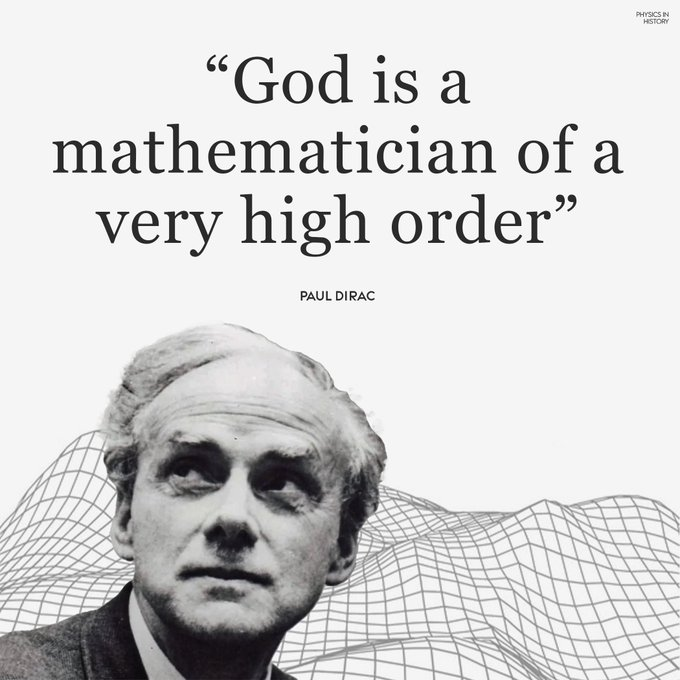
Paul Dirac's statement that "God is a mathematician of a very high order" resonated with millions after an image featuring the quote was posted on X (formerly Twitter) by @PhysInHistory, garnering over 78,000 views, 3,500 likes, and 500 reposts. This phrase, first shared in a 1963 Scientific American article, encapsulates the essence of Dirac's work and its profound impact on our understanding of the universe. At the heart of this is the notion that mathematics is a fundamental language of the universe, echoing the sentiment expressed by Albert Einstein, who once said, "The only thing that interferes with my learning is my education." Dirac's work embodies the intersections of physics and mathematics, and his legacy continues to inspire new generations of physicists and philosophers.
### A Brief Biography of Paul Dirac
Paul Adrien Maurice Dirac was born on August 8, 1902, in Bristol, England, to a Swiss father and English mother. He demonstrated exceptional mathematical talent from an early age and studied electrical engineering and mathematics at the University of Bristol before earning his PhD in mathematical physics from the University of Cambridge in 1926. Dirac's contributions to quantum mechanics were revolutionary, and he is perhaps best known for his formulation of the Dirac equation in 1928, which reconciled quantum mechanics with special relativity and predicted the existence of antimatter, as confirmed experimentally later on.
Dirac's life and work are a testament to the power of human ingenuity and the incredible advances that can be made when individuals combine their passion and intellect. His legacy continues to inspire physicists, philosophers, and mathematicians to this day and is often linked to other famous figures in history such as Albert Einstein, Erwin Schrödinger, and Niels Bohr.
### Key Facts and Figures
The Dirac equation, as a fundamental concept in quantum mechanics, has far-reaching implications on our understanding of the universe. The Dirac equation describes the behavior of electrons and predicted the existence of antimatter, which was later confirmed experimentally. This achievement earned Dirac the Nobel Prize in Physics in 1933, shared with Erwin Schrödinger.
In the years following Dirac's work, the Schrödinger equation, a foundational concept in quantum mechanics, has become a cornerstone of modern physics. The equation, developed by Austrian physicist Erwin Schrödinger, describes the time-evolution of a quantum system and is used to predict the behavior of particles at the subatomic level. The equation's power lies in its ability to describe the wave-particle duality of matter, where particles can exhibit both wave-like and particle-like behavior.
### Mathematics and the Universe
Dirac's work highlights the profound connection between mathematics and the universe, echoing the idea that "God is a mathematician of a very high order." His formulation of the Dirac equation demonstrates that mathematics can be used to describe the behavior of fundamental particles and forces, shedding light on the underlying structure of the universe. This connection is not unique to Dirac's work and has been explored by other scientists and philosophers throughout history, such as Isaac Newton and Andrew Wiles.
The idea that mathematics is a fundamental language of the universe has been explored by philosophers and scientists throughout history. The ancient Greeks, such as Pythagoras and Plato, believed that mathematics was a divine language that underpinned the universe. This idea has been echoed by modern scientists such as Stephen Hawking, who wrote, "The universe has no beginning or end. It is a big bang that will eventually be a big crunch." Hawking's work on black holes and the origins of the universe demonstrates the power of mathematics in describing the universe.
### Dirac and the Search for a Unified Theory
Dirac's work has inspired generations of physicists and mathematicians in their pursuit of a unified theory that describes all fundamental forces and particles. The Dirac equation, as a foundational concept in quantum mechanics, is a testament to the power of mathematics in describing the universe. The search for a unified theory is an ongoing effort, with scientists such as Stephen Hawking and Neil deGrasse Tyson continuing to explore the mysteries of the universe.
This effort is not without controversy, as the search for a unified theory has led to numerous theories and hypotheses. The concept of string theory, for example, proposes that the universe is composed of multiple dimensions and that particles are vibrations of these dimensions. While the theory has garnered significant attention, it remains a topic of debate among scientists.
### The Legacy of Paul Dirac
Dirac's legacy extends far beyond his work on the Dirac equation and the formulation of quantum field theory. His contributions to physics have inspired generations of scientists and philosophers to explore the intersections of mathematics and the universe. Dirac's work has also had a profound impact on our understanding of the universe, demonstrating the power of mathematics in describing the fundamental laws that govern reality.
The image shared by @PhysInHistory has sparked a renewed interest in Dirac's work and its implications for our understanding of the universe. The quote "God is a mathematician of a very high order" resonates deeply with those who believe in the power of mathematics to describe the underlying structure of the universe. As we continue to explore the mysteries of the universe, Dirac's work remains a cornerstone of modern physics and a testament to the enduring power of human ingenuity.
Paul Dirac was a British theoretical physicist born on August 8, 1902, in Bristol, England. He is best known for his formulation of the Dirac equation, which reconciled quantum mechanics with special relativity and predicted the existence of antimatter.
What is the Dirac equation?
The Dirac equation is a fundamental concept in quantum mechanics that describes the behavior of electrons and predicts the existence of antimatter. It was formulated by Paul Dirac in 1928 and is a key component of quantum field theory.
What is quantum field theory?
Quantum field theory is a theoretical framework in physics that describes the behavior of fundamental particles and forces in terms of fields that permeate space and time. Dirac's work on the Dirac equation was a key component of this framework.
Who else contributed to the development of quantum mechanics?
Many scientists contributed to the development of quantum mechanics, including Albert Einstein, Erwin Schrödinger, Niels Bohr, and Werner Heisenberg. Each of these scientists made significant contributions to our understanding of quantum mechanics and the nature of reality.
What is the connection between mathematics and the universe?
The connection between mathematics and the universe is a fundamental aspect of modern physics. Mathematics provides a language and framework for describing the fundamental laws that govern reality, as demonstrated by the Dirac equation and other scientific discoveries.
Conclusion
Paul Dirac's work continues to inspire physicists, philosophers, and mathematicians to explore the intersections of mathematics and the universe. His formulation of the Dirac equation, a cornerstone of modern physics, has had a profound impact on our understanding of the universe and the laws that govern reality. The image shared by @PhysInHistory has sparked a renewed interest in Dirac's work and its implications for our understanding of the universe. As we continue to explore the mysteries of the universe, Dirac's legacy remains a testament to the enduring power of human ingenuity and the importance of mathematics in describing the fundamental laws that govern reality.
This dispatch is for subscribers
Subscribe to to keep reading.
0 views
Comments (0)
‹ Prev
Next ›
Page not found
That dispatch or profile doesn't exist, or may have been removed.
Know something about this story?
You can add information to this dispatch — the author gets to review it.