
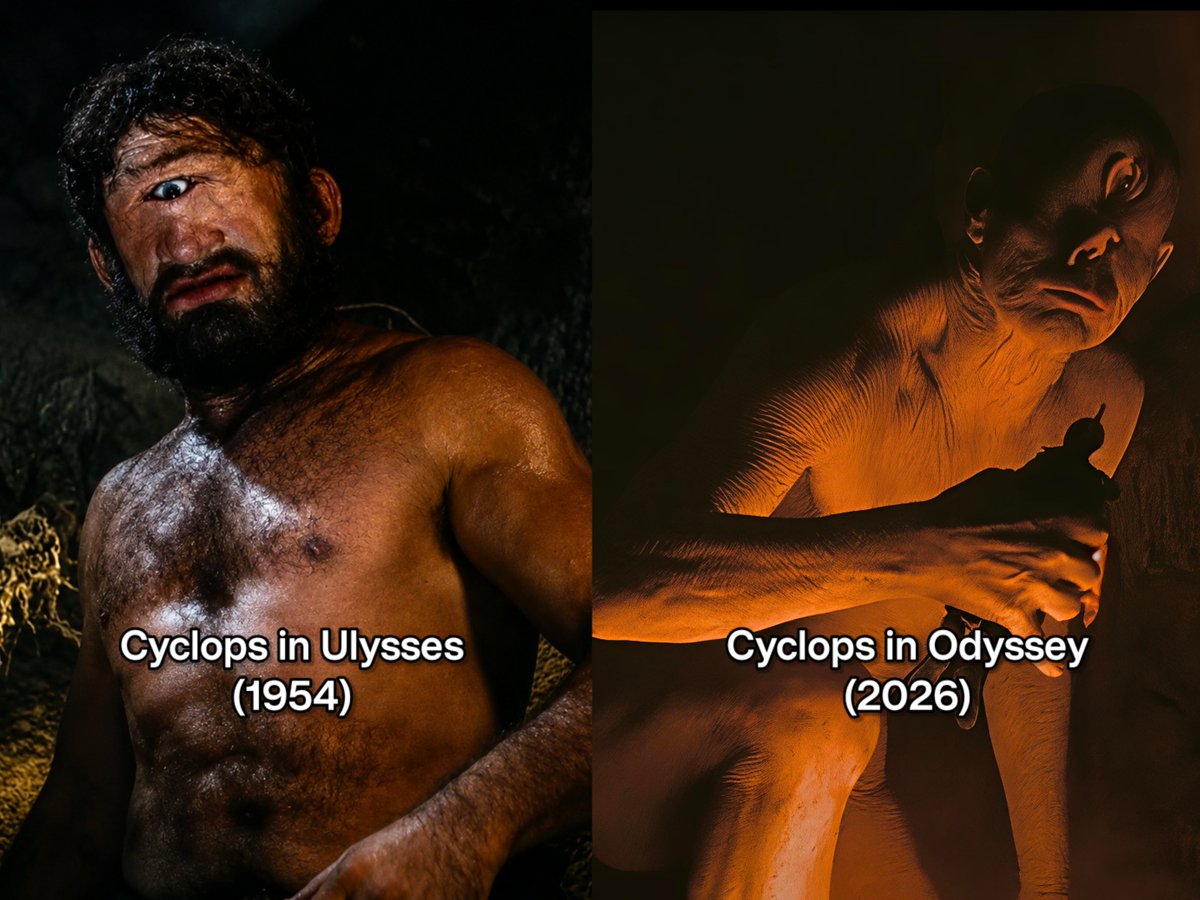
A single tweet has turned a classic Hollywood monster into a battlefield for modern CGI versus mid‑century practical magic. The post, shared by @magickbones on July 20 2026, juxtaposes the Cyclops from the 1954 Italian‑American epic Ulysses with the newly unveiled Polyphemus in Christopher Nolan’s blockbuster The Odyssey. Viewers immediately asked whether a 60‑foot animatronic‑plus‑CGI hybrid could look more believable than a rugged, bearded actor in prosthetic makeup. That matters because the debate revives a decades‑long conversation about how mythic beasts should be visualized for contemporary audiences, influencing everything from budget allocations to the training of future creature designers.
Christopher Nolan’s 2026 film The Odyssey introduced a new Cyclops design that many viewers say looks more realistic than the 1954 Ulysses version. The creature, played by Bill Irwin, combines a 60‑foot animatronic set with subtle CGI, and the debate exploded online after a comparison tweet earned over 6.5 million views on July 20 2026.
Homer’s Polyphemus and the roots of a one‑eyed giant
Homer’s Odyssey, composed around the 8th century BCE, introduces Polyphemus in Book 9 as a massive, one‑eyed shepherd son of Poseidon who traps Odysseus and his crew. The episode emphasizes the ancient Greek value of xenia—hospitality—while rewarding cleverness over brute force. Scholars suggest that the myth may have been inspired by oversized fossils or elephant skulls, whose single nasal cavity could be imagined as a giant eye socket. That matters because early storytellers blended observable nature with imagination, setting a precedent for visual artists to anchor fantasy in recognizable reality.
Because the original text describes the Cyclops as “a man of gigantic stature, with a single eye in the middle of his forehead,” filmmakers have long wrestled with how to translate that line into a tangible screen monster. The tension between literal description and artistic interpretation continues to shape every new adaptation.
Umberto Silvestri’s practical monster in Mario Camerini’s Ulysses
Umberto Silvestri donned a bearded, muscular suit to become Polyphemus in Mario Camerini’s 1954 film, which starred Kirk Douglas as Ulysses. The design relied on forced perspective, matte painting, and uncredited assistance from future horror legend Mario Bava, allowing a single actor to dominate the frame without digital aid. Budget constraints forced the crew to innovate with hidden rigs and practical lighting, creating a creature that felt “grounded and terrifyingly plausible” to 1950s audiences.
That matters because the 1954 Cyclops set a visual benchmark for practical effects, demonstrating that a well‑crafted human performance could rival the spectacle of later, technology‑driven monsters. Modern filmmakers still reference Silvestri’s work when they aim for a tactile, physical presence on set.
Nolan’s hybrid beast brings horror realism to the big screen
Nolan’s The Odyssey opened on July 17 2026, starring Matt Damon as Odysseus and Bill Irwin as the Cyclops. Production built a 60‑foot “contraption” inside Greece’s Nestor’s Cave, merging animatronic limbs with selective CGI to enhance eye movement and skin texture. Shot on IMAX film, the creature appears gaunt, shadowed, and almost animalistic, reflecting Nolan’s claim that he wanted “what would this be like in real life?”
That matters because the film illustrates a broader industry trend: high‑budget blockbusters are returning to practical set pieces while using CGI sparingly, a hybrid approach that aims to preserve the visceral impact of physical props while still achieving photorealistic detail. The design may influence future myth adaptations that seek to balance authenticity with audience expectations for spectacle.
A meme ignites a worldwide conversation about monster realism
A post by @magickbones on X (formerly Twitter) paired the 1954 Cyclops image with Nolan’s 2026 version, captioned “‘Realistic and accurate’ and we’re talking about a giant cyclops.” Within hours, the tweet amassed over 6.5 million views, spawning comment threads on Reddit, Discord, and niche film forums. The viral debate quickly turned into a case study for how meme culture can shape critical discourse around major releases.
Because the meme reached a mixed audience of mythology buffs and casual moviegoers, it forced the industry to reckon with a new metric of success: social‑media virality, not just box‑office numbers. The conversation also highlighted how audiences judge “realism” not merely on technical fidelity but on emotional resonance.
Opponents argue the new design sacrifices mythic grandeur
Critics argue that Nolan’s gaunt Cyclops strips away the iconic bulk that audiences associate with Polyphemus, turning a mythic titan into a horror‑movie creature. A review in Film Quarterly noted that the creature’s “emaciated silhouette feels less like a legendary giant and more like a nightmare creature, which may alienate fans of the original epic.” Opponents also point out that the heavy reliance on CGI—even if limited—creates moments where the creature’s eye fails to track properly, breaking immersion.
That matters because the pushback underscores a persistent split in the filmmaking community: one camp values literal fidelity to source material, while the other prioritizes visceral fear. Nolan’s choice may set a precedent for future directors who must weigh mythic scale against psychological horror.
Here’s how the team achieved the hybrid effect
- Design team studied elephant skulls at the Natural History Museum in London to model the single eye socket, linking ancient fossil inspiration to modern anatomy.
- Artisans constructed a 60‑foot steel skeleton inside Nestor’s Cave, allowing on‑set lighting to interact with real surfaces rather than green‑screen.
- Bill Irwin performed the Cyclops’s movements on a motion‑capture rig, providing a base layer for animatronic puppetry.
- Selective CGI was applied in post‑production to enhance skin texture and add subtle eye reflections, keeping the majority of the monster’s presence physical.
- Final color grading matched the cave’s natural amber tones, ensuring the creature blended seamlessly with the IMAX footage.
Because each step blended old‑school craftsmanship with cutting‑edge tech, the final monster feels both tactile and otherworldly, a balance that could become the template for future high‑budget epics.
Future myth adaptations may lean toward hybrid realism
Future studios are watching the Cyclops debate closely as they plan their own mythic adaptations, from Norse sagas to Arabian Nights. The success of Nolan’s approach—evidenced by a