
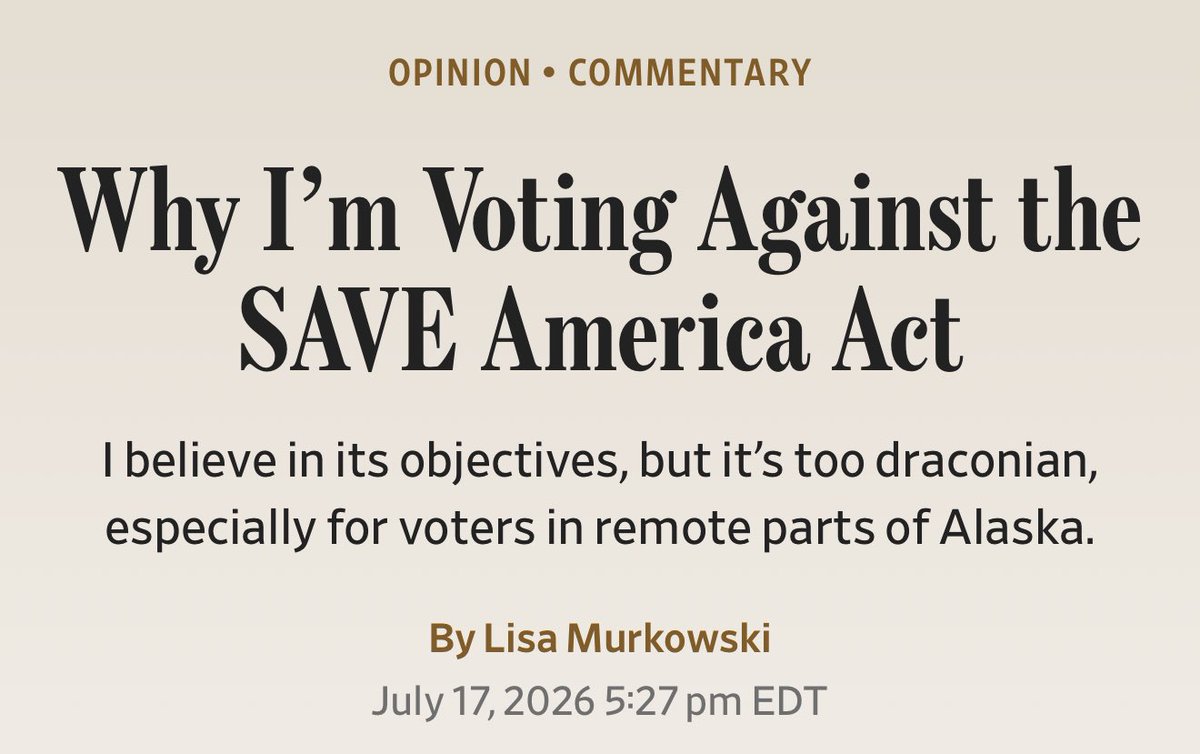
Republican senators have been wrestling over a federal voting‑security proposal that seeks to tighten registration rules nationwide. On July 18, 2026, former FBI deputy director turned commentator Dan Bongino used his X account to denounce Senator Lisa Murkowski’s decision to oppose the legislation, calling it an “absolute disaster for the party.” Murkowski, whose home state of Alaska voted overwhelmingly for the bill’s core ideas, published an opinion piece in the Wall Street Journal on July 17, 2026 explaining why she would vote against the SAVE America Act. The clash spotlights a growing rift between establishment Republicans who must balance statewide logistical realities and a vocal faction that prioritizes a uniform, hard‑line approach to election integrity.
On July 18, 2026, Dan Bongino criticized Senator Lisa Murkowski for voting against the SAVE America Act; Murkowski’s July 17 Wall Street Journal op‑ed argues the bill’s requirements would burden Alaska’s remote voters, prompting a debate within the GOP over election‑security priorities.
Historical backdrop and legislative momentum
Since the contested 2020 presidential election, congressional leaders have introduced multiple bills aimed at preventing non‑citizen voting and securing mail‑in ballots. The SAVE America Act emerged in early 2026 as the most comprehensive effort, consolidating proposals that had previously stalled in committee. Proponents cite documented instances of foreign nationals appearing on voter rolls in several swing states as justification for a national proof‑of‑citizenship requirement.
However, the drive for a uniform standard collides with longstanding state autonomy over election administration. Alaska, where a single‑day primary draws voters from isolated villages reachable only by air or boat, has historically relied on flexible identification practices. This tension illustrates how federal ambitions to standardize procedures can inadvertently disenfranchise populations that already face geographic hurdles.
Defining the SAVE America Act
The SAVE America Act mandates that anyone registering for federal elections must submit documentary proof of U.S. citizenship—such as a birth certificate, passport, or naturalization papers—and present a government‑issued photo ID at the polling place. It also seeks to create a federal database to verify voter eligibility across all 50 states.
By centralizing verification, the bill aims to eliminate discrepancies among state systems, yet it raises constitutional questions about the balance of power between the federal government and the states. Legal scholars note that previous Supreme Court rulings, including Arizona v. Inter Tribal Council (2015), have emphasized the need for states to retain primary control over voter qualifications, suggesting that the Act could face judicial scrutiny.
Murkowski’s opposition and Alaska‑specific concerns
In her July 17 Wall Street Journal op‑ed titled “Why I’m Voting Against the SAVE America Act,” Murkowski affirmed support for the bill’s “core tenets” but labeled the final language “draconian” for Alaska. She emphasized that many rural and Native Alaskan voters lack ready access to the required documents, and that the implementation timeline would be “unrealistic.” The full text of her statement can be read on the senator’s official site press release.
Beyond logistical hurdles, Murkowski’s stance reflects a strategic calculation to preserve her electoral coalition, which includes a sizable Indigenous electorate that traditionally leans Democratic on social issues but remains fiscally conservative. By opposing a bill that could suppress turnout in remote districts, she signals a willingness to diverge from party hardliners, a move that may safeguard her 2028 re‑election bid while inviting criticism from the party’s base.

Dan Bongino’s firestorm and the RINO narrative
On July 18, 2026, Bongino posted a screenshot of Murkowski’s op‑ed on X, adding, “She does this every time. Absolute disaster for the party, and the movement.” The post accumulated more than 29,000 likes and over 700,000 views within hours, underscoring the resonance of his message among a segment of the conservative base. His tweet can be viewed in the embedded video below.
Bongino’s criticism stems from a personal incentive to reinforce his brand as a staunch defender of the “MAGA” agenda, a brand that thrives on highlighting perceived moderate defections. Simultaneously, the Republican leadership aims to keep moderate senators like Murkowski on board to secure the 51‑vote supermajority needed for certain procedural moves. This clash of incentives creates a feedback loop: heightened public rebuke may pressure Murkowski, while party leaders may double‑down on outreach to prevent a broader exodus of centrist votes.
Liberty scores and intra‑senate pressure
The Conservative Review’s F Liberty Scores released a graphic that placed Murkowski at 29, alongside Senators Susan Collins, Shelley Moore Capito, and Lindsey Graham, each receiving scrutiny for voting records that deviate from the organization’s checklist. The image was widely shared in reply threads to Bongino’s post, reinforcing a narrative that labels such senators as insufficiently conservative.
These scores function as a quantifiable lever for primary challengers, who can cite the numbers when courting donors and grassroots activists. For Murkowski, a low score threatens fundraising pipelines that rely on national Republican Action committees, yet her Alaska‑focused campaign has historically drawn substantial independent‑expenditure support. The divergent incentives—national party apparatus seeking uniformity versus a state‑specific electoral calculus—may shape whether the SAVE America Act survives a Senate vote or is stripped of its most contentious provisions.

What lies ahead for the legislation
Committee chairs have scheduled a markup session for the SAVE America Act in early August 2026, giving senators a narrow window to propose amendments that could soften the proof‑of‑citizenship clause. If Murkowski and other moderates succeed in inserting language that allows state‑level waivers for remote areas, the bill might retain enough support to pass the Senate floor.
Conversely, if hard‑line members leverage the high Liberty scores to rally a coalition against any concession, the bill could stall, prompting leadership to revive a scaled‑down version in the 2027 session. The outcome will likely hinge on whether the GOP leadership prioritizes short‑term electoral messaging—exemplified by Bongino’s viral post—or longer‑term legislative viability that accommodates Alaska’s unique voting landscape.
For more on this, see why im voting against the save america act 139faa0b.
Frequently Asked Questions
Conclusion
When Murkowski announced her vote against the SAVE America Act, she placed Alaska’s logistical realities at the forefront of a national debate that pits uniform election security against regional accessibility. The ensuing backlash from Dan Bongino illustrates how a single dissenting voice can amplify underlying party fractures, especially when media metrics like 29,000 likes signal a mobilized base. As Senate leaders weigh whether to amend the bill before the August markup, the competing incentives of preserving a fragile supermajority and appeasing a vocal conservative grassroots will dictate the legislation’s fate. Whether the final version accommodates Alaska’s remote voters or proceeds unchanged will serve as a barometer for the GOP’s ability to reconcile its national agenda with the diverse needs of its individual states.