
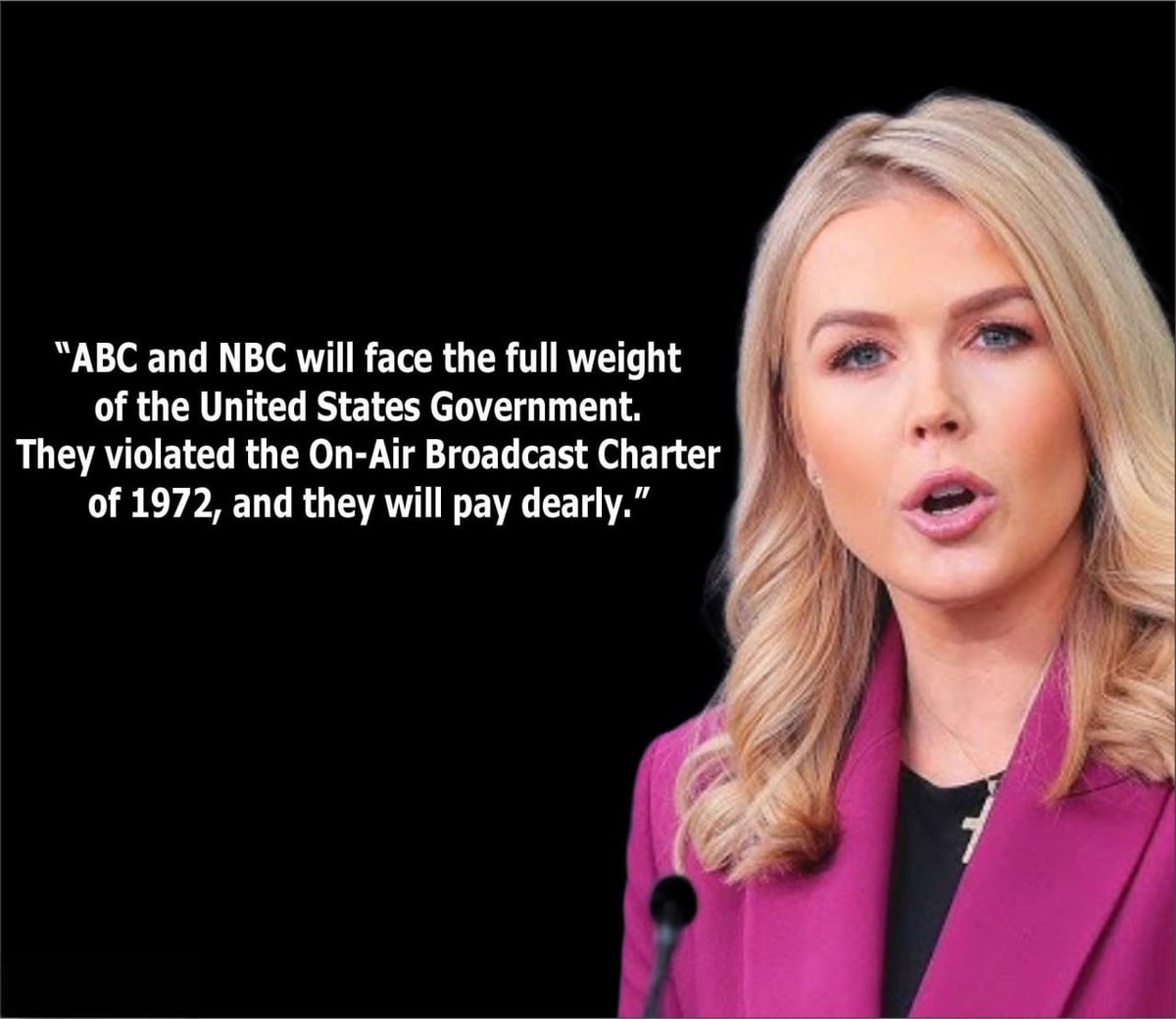
Every evening, millions of households tune in to ABC or NBC for news, weather and sports; a claim that those same networks could face federal sanctions for not showing a presidential speech threatens that routine. On July 18, 2026, an X post from @mcafeenew asserted that White House Press Secretary Karoline Leavitt warned ABC and NBC would “pay dearly” for refusing to air President Donald Trump’s primetime address. The post cited a non‑existent “1972 On‑Air Broadcast Charter” and mentioned ad pulls by Coca‑Cola and General Motors. As the story spread, viewers began questioning whether their favorite channels might lose programming or face fines, a concern that directly touches their access to local news and entertainment.
On July 18, 2026, a viral X post claimed White House Press Secretary Karoline Leavitt threatened ABC and NBC with government penalties for not airing President Donald Trump’s address, but fact‑checkers found no evidence of such a warning and no law called the “1972 On‑Air Broadcast Charter.”
Background of the Viral Post and Broadcast Landscape
July 18, 2026 saw the X account @mcafeenew, a fan page for the late John McAfee, publish a graphic warning that ABC and NBC would face the “full weight of the U.S. Government.” The post amassed more than 25,000 likes and 7,900 reposts within hours, illustrating how quickly misinformation can gain traction on social platforms. The account’s bio references “WWG1WGA,” a slogan tied to a broader conspiracy network that often amplifies claims of media bias. This matters because viral posts can shape public perception before any official clarification appears, pressuring networks and regulators alike.
Historical patterns show similar spikes during past elections; in 2020, a rumor that the FCC was planning to revoke licenses of “biased” stations sparked brief market jitters despite lacking any regulatory proposal. The 2026 incident mirrors that dynamic, demonstrating that timing—mid‑July, just days after Trump’s address—magnifies the impact of unverified claims.

Legal Framework Governing Broadcasts and the Myth of a 1972 Charter
U.S. broadcast regulation originates from the Communications Act of 1934, which created the Federal Communications Commission (FCC) and set licensing requirements for public airwaves. No statute called the “1972 On‑Air Broadcast Charter” appears in the Code of Federal Regulations, and the FCC has never issued a rule by that name. The misconception likely arises from the 1972 revision of the FCC’s public interest standards, a technical update that does not impose penalties for refusing a presidential speech.
Understanding the actual legal landscape matters because it undercuts the post’s claim of an imminent “government hammer.” Past enforcement actions, such as the 1971 FCC order compelling networks to broadcast the Watergate hearings, required a court subpoena rather than an automatic penalty. Comparing that precedent to the 2026 allegation reveals a gap: the government lacks a direct mechanism to fine a network solely for editorial decisions, a nuance that many viewers overlook.
Network Decisions Not to Air Trump’s Address
President Donald Trump delivered a primetime address on July 16, 2026, focusing on election integrity and alleging that Chinese actors accessed roughly 220 million voter records. ABC, NBC, CBS and CNN each announced they would not broadcast the speech live, citing “unverified claims” that could undermine public confidence. Executives from ABC and NBC released statements emphasizing their responsibility to fact‑check before providing a platform for potentially false assertions.
Editorial discretion has precedent; during the 2021 Capitol riot coverage, several outlets delayed live feeds to verify footage. The decision in 2026 therefore aligns with a broader industry practice of weighing journalistic standards against real‑time access. Linking to a prior analysis of the blackout, readers can explore the detailed timeline at Trump’s Prime‑Time Address Blacked Out by ABC, NBC and CBS, which contextualizes the networks’ rationale.

What This Means for Ordinary Americans
Even though the alleged penalties lack legal basis, the rumor sparked tangible concerns among viewers. If a network were fined, advertising rates could rise, potentially affecting local businesses that rely on affordable spots. Additionally, viewers worried that future political speeches might be censored, limiting their ability to hear elected officials directly.
- Potential increase in local ad costs if networks face hypothetical fines.
- Reduced availability of live political content on major broadcast channels.
- Greater reliance on streaming platforms for uncensored speeches.
- Heightened skepticism toward network news credibility.
These practical effects matter because they translate abstract legal debates into everyday expenses and media choices. A similar panic occurred in 2018 when rumors of FCC fines on internet service providers led some households to switch to alternative broadband plans, illustrating how perceived regulatory threats can shift consumer behavior.
Political Reactions and the Critics’ Viewpoint
Republican lawmakers seized on the viral claim, with Senator James Rogers (R‑TX) filing a brief questioning the FCC’s “potential overreach” in punishing networks. Critics argue that the post reflects a broader strategy to pressure media outlets through “government‑backed intimidation.” Conversely, media‑industry groups such as the National Association of Broadcasters (NAB) issued a statement defending editorial independence and warning against politicizing regulatory processes.
Opponents of the post’s narrative note that invoking a fictitious charter distracts from genuine concerns about misinformation. By focusing on an imagined legal weapon, they risk overlooking the real challenge of balancing free speech with responsible journalism—a balance that has historically shifted after major events like the 9/11 attacks, when newsrooms tightened verification protocols.

Next Steps and Fact‑Checking Landscape
Major fact‑checking organizations, including PolitiFact and FactCheck.org, published analyses on July 19, 2026 confirming that no official statement from the White House exists regarding penalties for ABC or NBC. Their reports highlighted that the White House press briefings on July 17 and July 18 contained no mention of a “1972 On‑Air Broadcast Charter.” This verification effort matters because it provides a reliable counterpoint to viral misinformation circulating on platforms with limited editorial oversight.
Looking ahead, media literacy advocates suggest that viewers verify claims through multiple reputable sources before sharing. The episode also underscores the need for platforms to label disputed political content, a policy the Federal Trade Commission is currently reviewing. If such labeling becomes mandatory, future rumors may lose the rapid amplification seen in this case.
Frequently Asked Questions
Conclusion
While the viral claim that Karoline Leavitt threatened ABC and NBC with government sanctions proved unfounded, the episode highlights how quickly false legal narratives can influence public opinion. For everyday viewers, the real takeaway is to rely on official sources—White House releases, FCC filings, and reputable fact‑checkers—when evaluating sensational headlines. Maintaining that habit shields both personal media choices and the broader democratic conversation from baseless intimidation.