
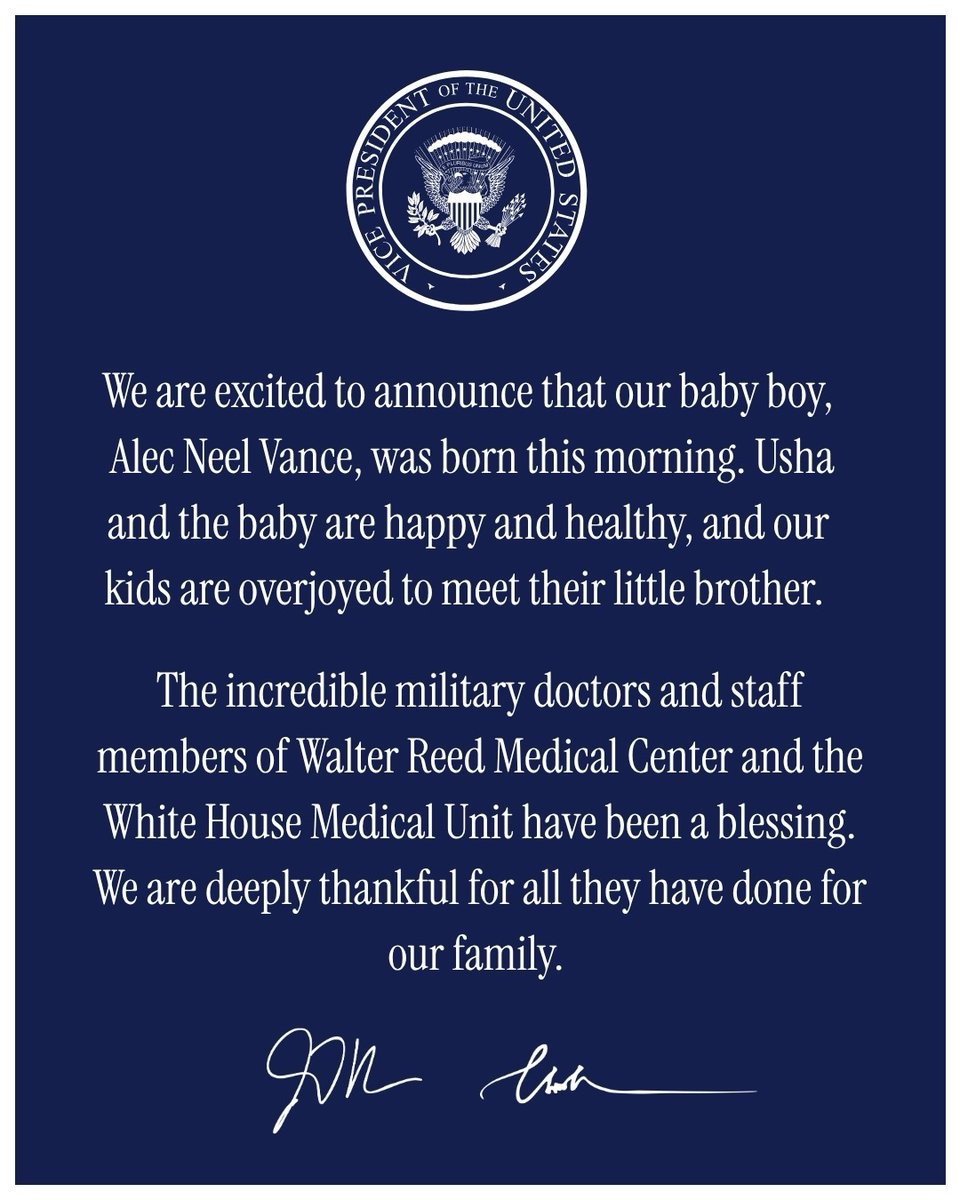
Vice President JD Vance and his wife Usha welcomed their third child, a son named Alec Neel Vance, on the morning of July 19, 2026. This birth arrives as the Trump‑Vance administration pushes a
Vice President JD Vance and his wife Usha announced on July 19, 2026 via X that their son Alec Neel Vance was born healthy at Walter Reed Medical Center. The birth marks the Vance family’s third child and has drawn bipartisan congratulations.
Key Facts
Vice President JD Vance and his wife Usha announced the birth of their son Alec Neel Vance on July 19, 2026 via X, noting that both mother and child were healthy. The announcement highlighted the involvement of military doctors from Walter Reed Medical Center and the White House Medical Unit.
Timing of the announcement coincides with the administration’s effort to showcase family‑friendly policies ahead of the 2026 midterms, a tactic reminiscent of the 2008 Obama campaign’s emphasis on “family values” to broaden voter appeal. 
Family Background
JD Vance grew up in Middletown, Ohio, later earning a degree from Yale Law School before entering venture capital, authoring a bestseller, and serving as U.S. Senator from Ohio prior to his vice‑presidential role. Usha Vance, née Chilukuri, also graduated from Yale Law and has built a career as a lawyer while maintaining a public presence that highlights cultural integration.
Both partners married in 2013, a union that has been presented as a cornerstone of the Vance brand of traditional family values. Critics argue that the emphasis on a “pro‑family” narrative may mask policy choices that favor certain demographic groups, creating tension between the administration’s rhetoric and its legislative record. Election‑integrity testimony earlier this year illustrated how personal narratives are leveraged to soften contentious policy debates.
Announcement Details
Official X post displayed a deep‑blue graphic bearing the vice‑presidential seal and read, “We are excited to announce that our baby boy, Alec Neel Vance, was born this morning… Usha and the baby are happy and healthy.” The message concluded with gratitude toward the “incredible military doctors and staff members.”
Choosing a formal seal for a family announcement suggests an intention to frame the event as a matter of national interest rather than a private celebration, echoing the 2011 announcement of President Obama’s daughter Malia’s college acceptance that also used official branding.
Political Reactions
Congratulatory messages arrived from a wide spectrum of accounts, including @libsoftiktok, Republican senators, and Democratic governors, illustrating a rare moment of bipartisan positivity. Some statements emphasized the Vances’ dedication to public service, while others simply offered well‑wishes for the newborn.
Critics argue that the administration is using the birth as a distraction from ongoing controversies surrounding election‑integrity legislation and the upcoming midterm battles, noting that personal milestones have historically been employed to shift media focus. Debate over Somali welfare reliance showed a similar pattern of policy debate intersecting with personal narratives.
U.S. Impact
Trump‑Vance administration recently rolled out the “Trump Accounts” program, granting
Comparison with the 2009 expansion of the Child Tax Credit, which provided up to
Future Steps
Walter Reed Medical Center and the White House Medical Unit continued to provide care for both mother and child, reinforcing the administration’s narrative of military‑supported healthcare excellence.
Visibility of these institutions may bolster upcoming defense‑budget discussions, where the administration plans to increase funding for military hospitals by 5% in fiscal year 2027. Continued public exposure of the Vance family’s medical experience could translate into broader public support for such spending.
Additional footage from the Vance X feed shows the family’s older children holding a “Welcome Alec” sign, a moment that humanizes the vice president’s public image.
Frequently Asked Questions
Conclusion
American readers should monitor how the Vance family’s newest addition influences the administration’s messaging ahead of the 2026 midterms, especially as the “Trump Accounts” credit program gains traction. Upcoming congressional hearings on defense spending may feature references to the Walter Reed experience, using the birth as a subtle illustration of military‑supported healthcare. Observers will also watch whether bipartisan goodwill generated by the announcement translates into measurable shifts in public opinion on family‑oriented fiscal policies. Keeping an eye on the Vance family’s public appearances will provide clues about the administration’s broader strategy to blend personal narrative with policy promotion.